

Islamic Relief Worldwide is an international Humanitarian and Development NGO with a presence in over 40 countries. Founded in 1984 in Birmingham the organisation has worked during some of the most significant moments of humanitarian crisis in the last four decades. This has including cyclone in Bangladesh in 1991, crisis in Bosnia and Chechnya in the 1990s, crisis in Iraq and Afghanistan in 2000s, Tsunami in Asia in 2006, and significant earthquakes in Haiti in 2010 and Pakistan in 2006. Islamic Relief continues to work in response to humanitarian crisis today in Yemen, Afghanistan and Syria amongst others, undertakes development work in Africa, Asia and Europe and advocates on issues such as climate and gender justice.

Islamic Relief’s public archive service opened in 2021. One of the reasons it has been so important to preserve our archive and make it available is that it documents a true grass-roots history of community action, volunteering and fundraising by Muslim communities both in the UK and internationally. Our archive reflects a unique story of voluntary action from a Muslim perspective, nowhere is this more evident than in records relating to seasonal Ramadan activities.
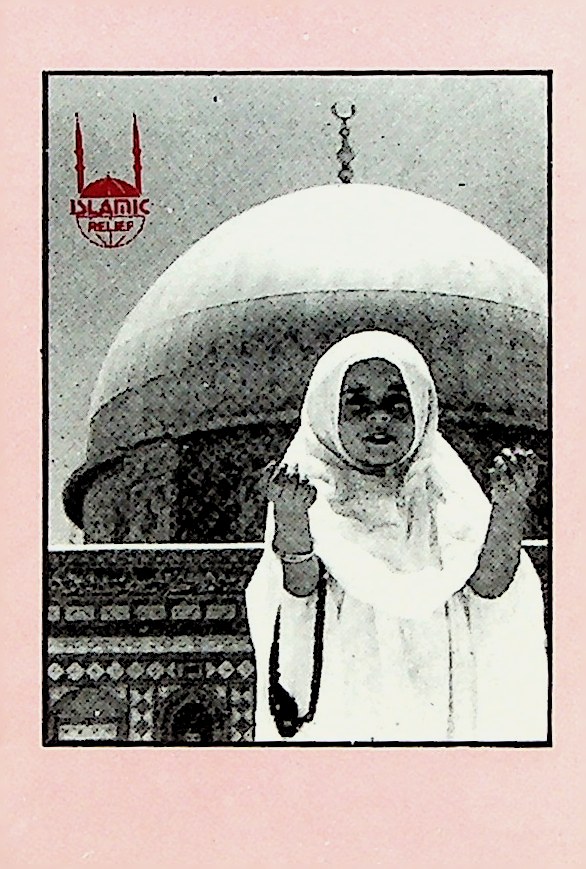
Ramadan is a month of fasting and reflection in Islam that culminates in the celebration of Eid al Fitr at the end of the 29-30 day period. In 2022 the beginning of Ramadan falls in the first week of April, so at the time of posting Ramadan is well under way! Ramadan is a time of year in which Muslims are reminded to think of and assist others at home and around the world and as such it is a time when many choose to give to charity. In particular, many choose this holy month as the time in which to give their annual zakat payments (a form of charitable giving obligatory for Muslims). Due to the increase in charitable giving at this time of year, Ramadan has always been a crucial season for fundraising at Islamic Relief and it is the time of year in which the most money is raised from community donations.
In its first years of existence, Islamic Relief operations were entirely volunteer-led raising funds primarily through collections in Mosques and other community organisations. From 1989, UK efforts to fundraise during Ramadan centered on the organisation of a nationwide tour of UK mosques in a van known as ‘The Caravan’. Volunteers travelled up and down the country giving up the opportunity to spend time with their own families during Ramadan to raise much needed funds. They hosted a travelling exhibition about Islamic Relief’s work and sold small items such as prayer mats, decorative household items and Islamic literature.
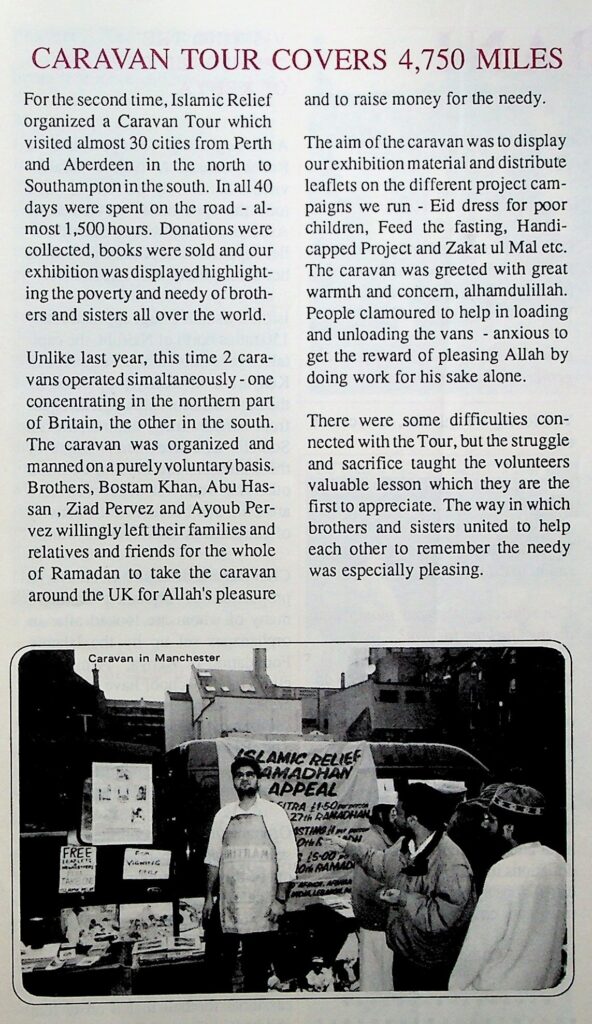
By the 1990s ‘The Caravan’ tour had become the ‘Ramadan Tour’ of mosques. It was complimented by dedicated fundraisings staff that coordinated community action and increasingly media campaigns in community and national newspapers, on radio and on TV. Dedicated regional volunteer offices were established in Manchester, Bolton, the West Midlands, East Midlands, London and Glasgow. Volunteer activities during Ramadan included operating call centres, visiting mosques, schools and other community organisations and distributing flyers and newsletters door to door in areas with high Muslim populations.
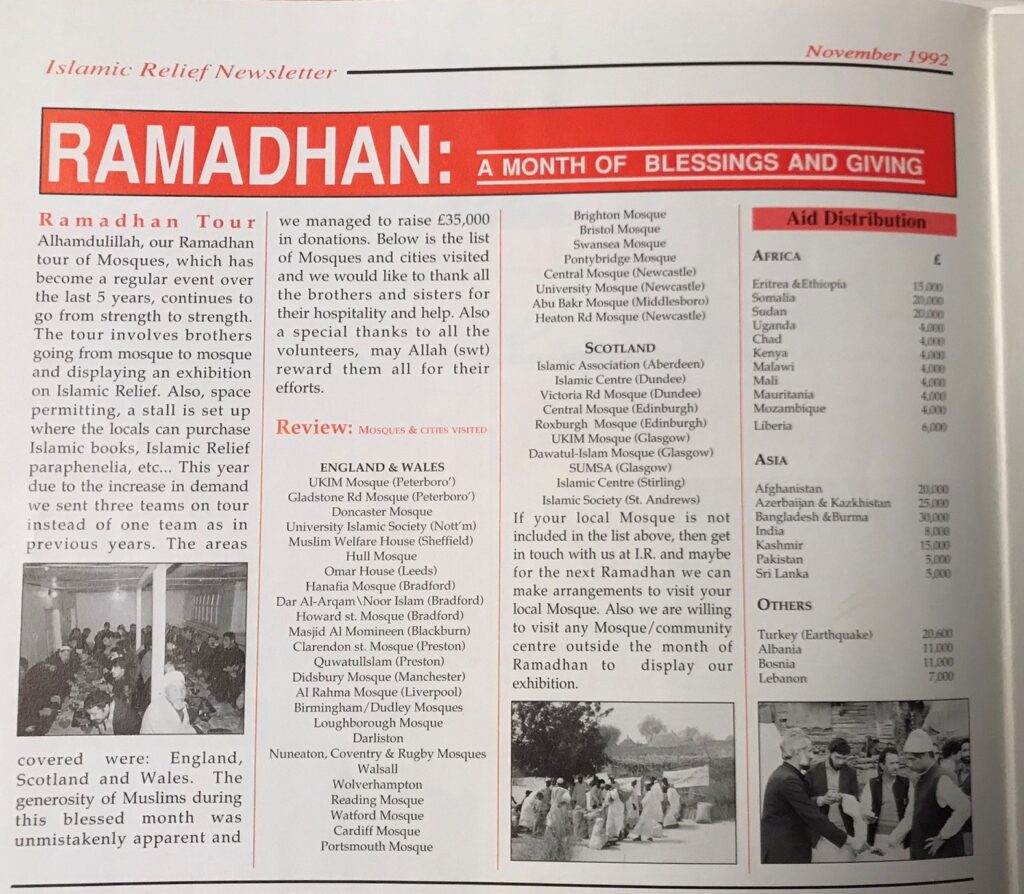
Post-Ramadan analysis reports from this time are revealing of what motivated individuals to give to Islamic Relief. Time and again, the need to build trust with communities as a legitimate and bone fide charity was a key aspect of what donors were looking for when choosing to donate. It’s no surprise that then as now, people wanted to know that their donations are being spent in a legitimate, transparent and accountable way. Islamic Relief was fortunate here as it could demonstrate directly through organised staff talks and literature that its work was impacting prominent humanitarian crisis of the time. Taking for example 1994’s Ramadan campaign, the largest section of funds (apart from general and zakat donations) were collected to be allocated to the Bosnia Crisis Appeal relating to conflict that took place 1992-1995. Talks featuring Bosnia experienced members of Islamic Relief staff and Iftar (meal to break daily fast at sunset) and other events specifically in aid of Bosnia were popular. Similarly, post Ramadan analysis in 1995 showed that apart from general and zakat payments, the single biggest fund donated to was the Chechnya Crisis Appeal related to the war in Chechnya 1994-1996.
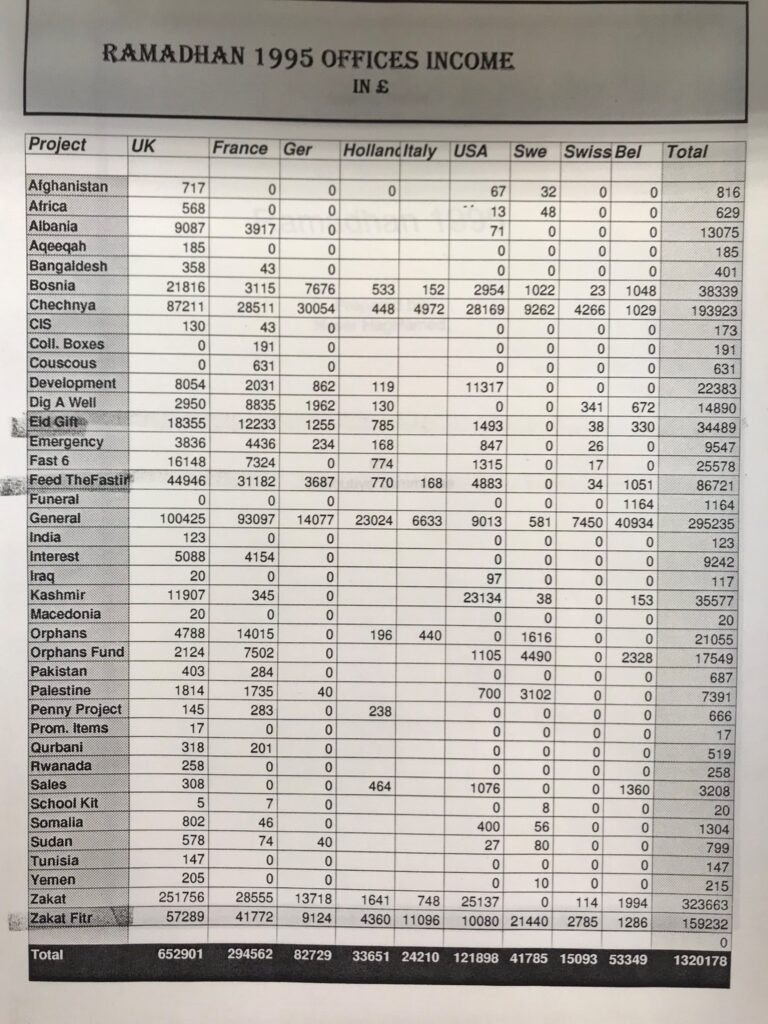
It was also during the 1990s that Islamic Relief began establishing fundraising offices known as ‘Partner Offices’ internationally, notably in the USA, Canada and several European countries including France, Germany, Switzerland and the Netherlands. Ephemera printed in the respective language of these countries was produced and in addition, languages commonly used by Muslim communities in each country were printed. For example in Germany, the Islamic Relief newsletter was translated into both German and to Turkish, the largest group of Muslims in Germany being from the Turkish diaspora.
The 2000s saw a period of expansion at Islamic Relief in terms of the scale of projects implemented internationally and also income. In particular, Islamic Relief was increasingly receiving grant funding from bodies such as the European Commission Humanitarian Aid (ECHO), the UN and the UK Department for International Development (DFID). These funds were allocated for work all over the world but in particular in in this period for work during crisis in Iraq and Afghanistan. Community income during this period also grew, with Ramadan and the grass-roots efforts of volunteers remaining a mainstay. In 2013 Islamic Relief first implemented it’s highly successful ‘Cakes Campaign’ in aid of the crisis in Syria. This campaign was first begun by a small group of volunteers in Bradford and is now in its 10th year as conflict and humanitarian crisis in Syria sadly continues into its 12th year in 2022. The idea behind this long-running now national campaign is to buy a cake for yourself, your family or a friend and Islamic Relief volunteers will deliver it to your door. This campaign utilised Ramadan celebrations and Iftar observances whilst also tapping into concerns and desires to assist those affected by a significant crisis prominent in contemporary headlines.
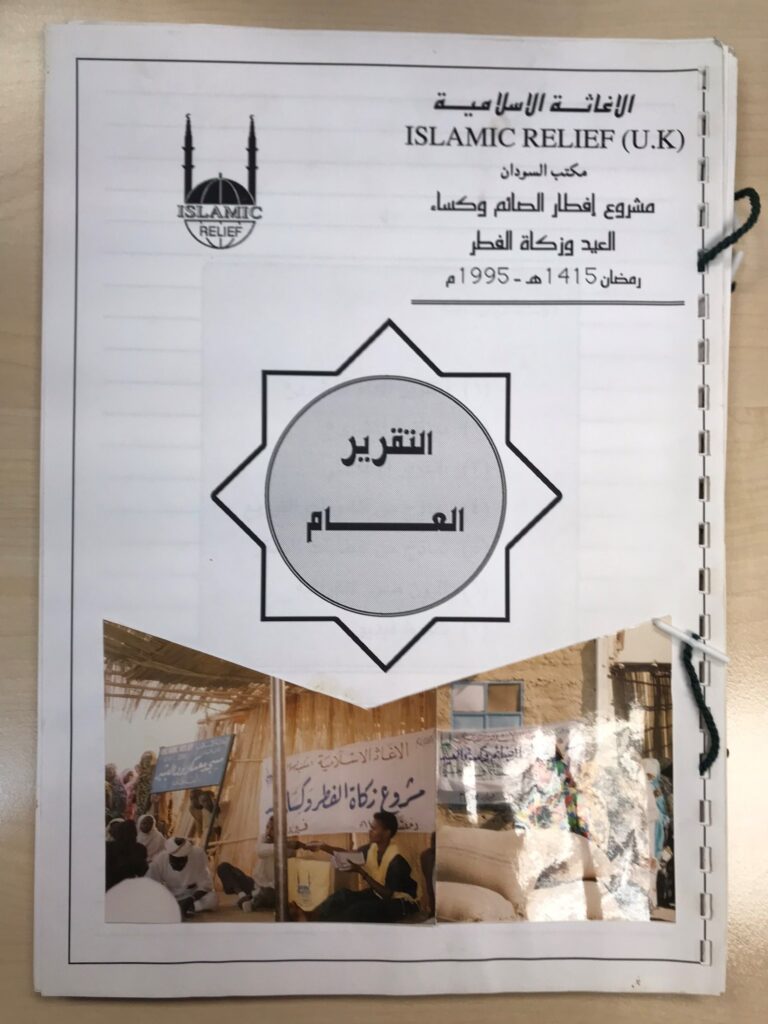
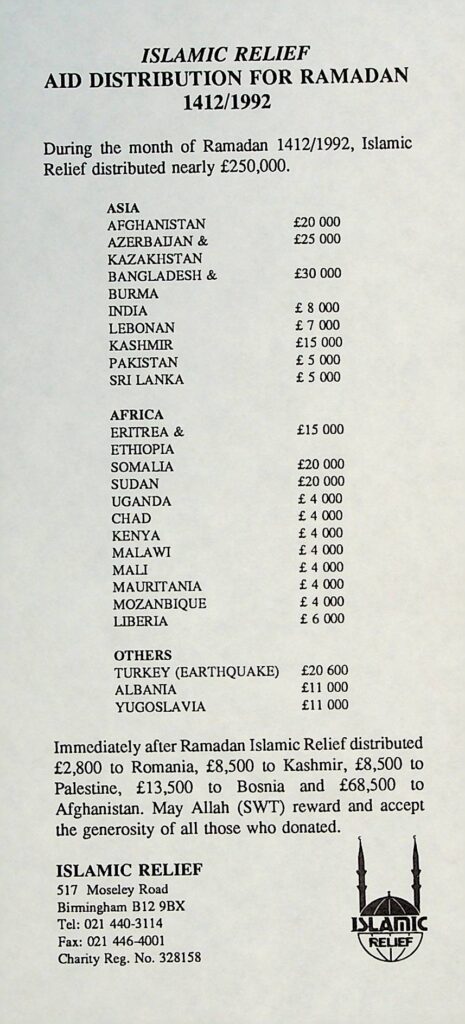
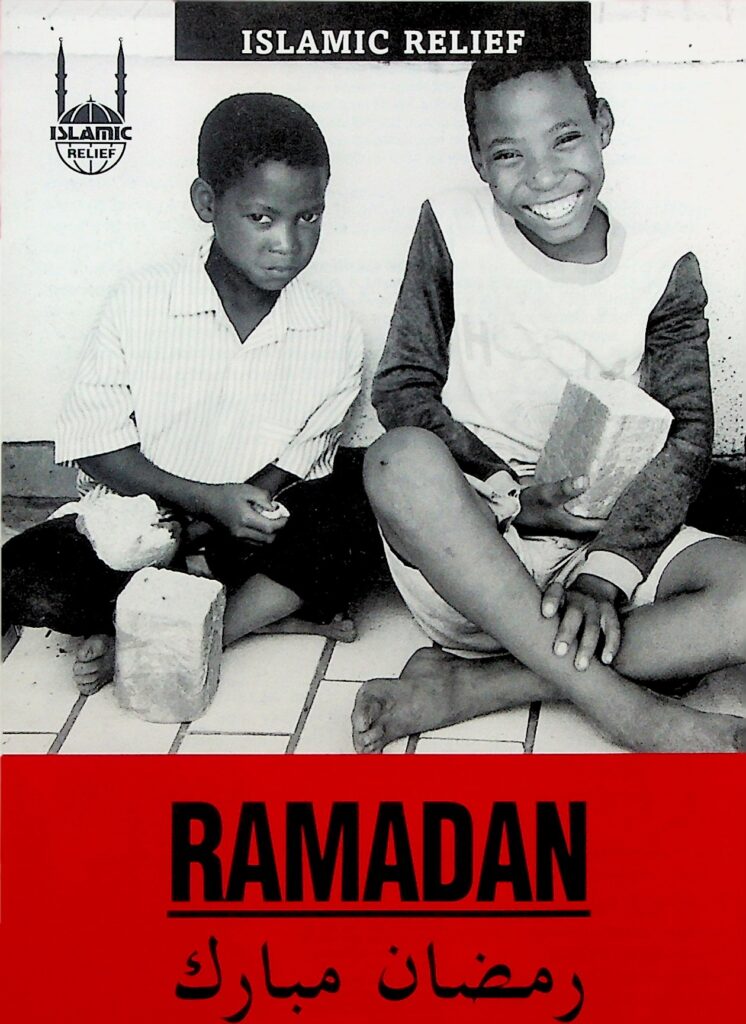
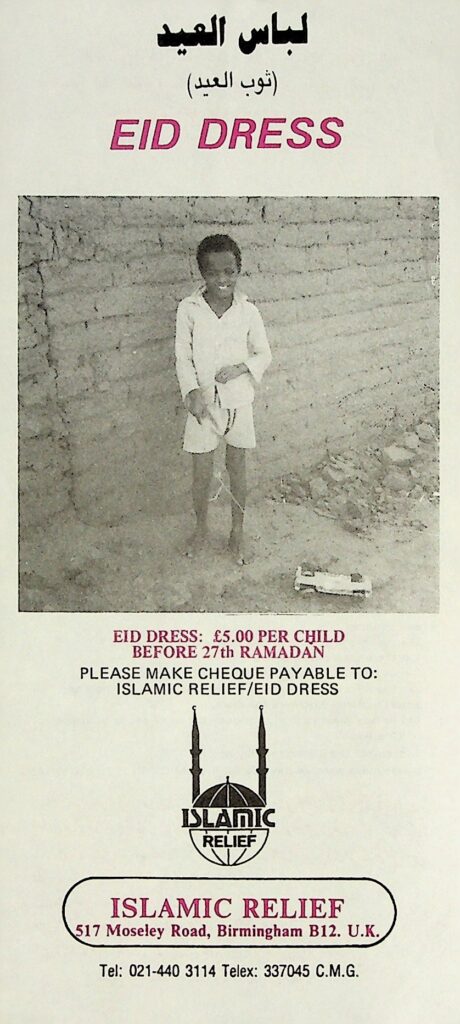
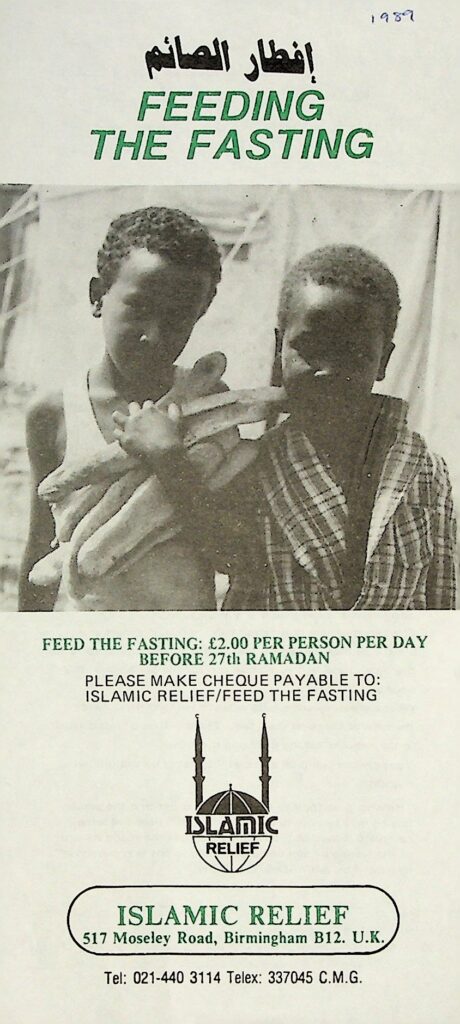
As we have seen, over and over again throughout the years those that gave to Islamic Relief during Ramadan were motivated to do so as a part of their regular charity giving and observation of Islam, but also in aid of particular campaigns and projects that captured hearts, minds and contemporary headlines. In addition to funds spent on crisis appeals, Islamic Relief has also regularly implemented humanitarian projects during Ramadan itself. Often these projects have comprised a distribution of packs of food items to communities around the globe. In the 1980s ‘Feed the Fasting’ and ‘Eid Dress’ projects aimed to ensure fasting families had something to break their fast with and that children had new quality clothes to wear for Eid and a seasonal gift. Distribution of food packs to Muslim and non-Muslim communities during Ramadan have continued until the present day.
Ramadan is and always has been a vital time of year in which both funds are raised and global communities are assisted by Islamic Relief. The Islamic Relief Archive documents and reflects both of these aspects of the organisation’s seasonal activity. It also demonstrates significant voluntary action by global Muslim communities inspired by faith and motivated by humanitarian concerns around the globe. Ramadan Kareem to everyone observing this month and enjoy Eid celebrations at the end!
Elizabeth Shuck, Archivist
The Islamic Relief Archive catalogue is available on the Archives Hub and The National Archives websites.