
Conceptualising and contextualising a neglected archives sector
In this ‘Spotlight’ article Paul Beard introduces his Arts and Humanities Research Council project on charity archives at risk
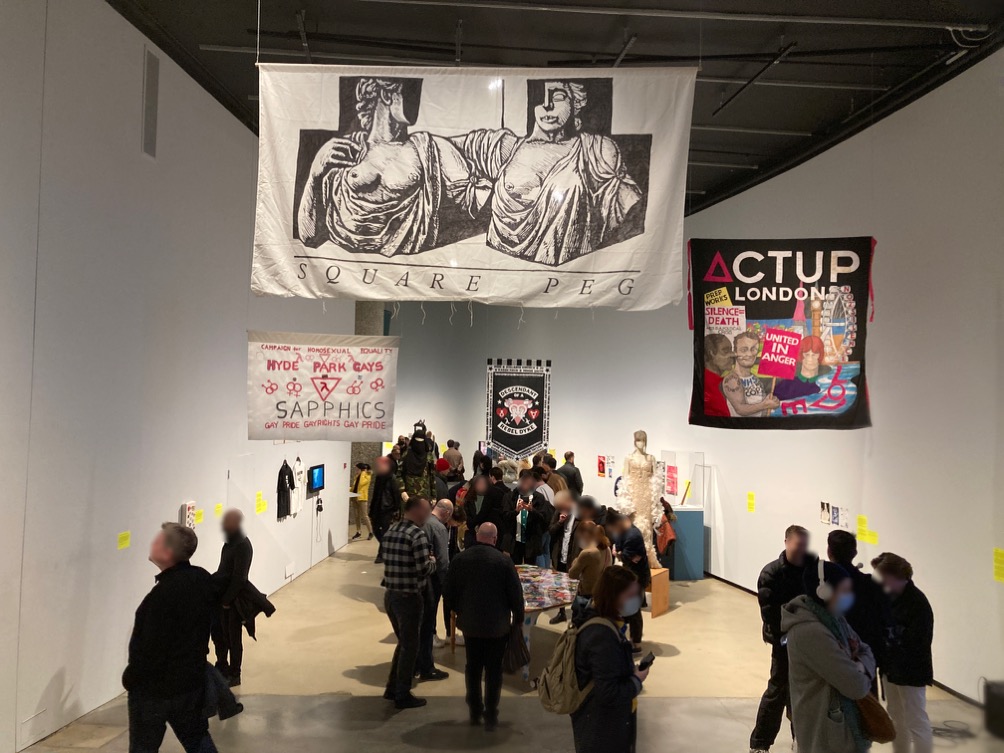
In late February 2022, the Bishopsgate Institute staged a take-over of The Curve at the Barbican with an archive installation titled Out and About! Archiving LGBTQ+ history at Bishopsgate Institute. Running for a month, Out and About displayed material that explored the lived experiences of LGBTQ+ people, collectives and organisations in London, with topics ranging from the gay rights movement, protest, performing arts and social life. Included in the exhibition were objects, ephemera and media from many London-based LGBTQ+ charities including posters from the Terrence Higgins Trust and a logbook from Switchboard, an LGBTQ+ telephone helpline, dating from the late 1980s. The exhibition highlighted the role of archives in remembering the everyday celebrations and struggles of LGBTQ+ Londoners, as well as demonstrating the vital role of charity archives in documenting histories that have long evaded ‘official’ records.
There is a long and rich tradition of charity in England, with voluntary action being central to almost every social, cultural and political movement. A definition from the National Council of Voluntary Organisations (NCVO) describes a charity as ‘an organisation with specific purposes defined in law to be charitable – and is exclusively for public benefit’. Although charities appear in many different shapes and sizes, they all share a common goal of working to benefit the public and be non-profit. Yet this is far from a recent phenomenon. Charity, as a virtue, has ancient roots with practices such as almsgiving, appearing across many world cultures and religions. In England, the precursor to the modern charitable organisation has been attributed to the friendly societies and associations of the 17th and 18th centuries. Likewise, the legal status of charities has changed considerably over time and is complex – NCVO briefly outlined the complexity of the sector and its many legal challenges in a briefing document available here.
The voluntary sector in England is diverse and dynamic. In England and Wales, there are 13 broad recognised charitable purposes recognised in the Charities Act 2011 that range from community development to emergency services; animal welfare to international aid. NCVOs provide a detailed analysis of the voluntary sector, publishing statistics on the size and scope of sector in its annual Civil Society Almanac. According to the 2021 edition, there were 163,150 voluntary sector organisations in the UK, with 129,120 operating in England. The vast majority of are small with an income under £100,000. The types of organisations range from parent teacher associations and amateur dramatic societies through to international aid organisations and large medical research institutions.
Under current law the archives and records of charities in England and Wales are considered private assets, a feature shared with other categories of private archives. As such, their records are afforded very few legal protections. Charities are navigating a complex regulatory landscape where recordkeeping requirements are rarely explicitly outlined. Because the records organisations are expected to create and retain differ depending on their charitable purposes, providing useful and relevant guidance is challenging.
The risk to charity archives in England has been acknowledged by many, with similar trends observed across the UK and internationally. In 2004, a special edition of the Records Management Journal was dedicated to recordkeeping practices in the voluntary sector, with contributions made by members of CHARM that highlighted the risk to charity archives. In 2014, Matthew McMurray published a report titled Charity Archives in 21st Century which analysed the many different ways that the archives and records of charities are vulnerable to loss. In 2017, a report commissioned by The National Archives (TNA) by Caroline Williams, identified the records of charities as one of the five categories of archives that were at high risk of loss. More recent research conducted as part of the Discourses of Voluntary Action project has outlined the positive outcomes of collaborative interventions between academics and organisations, and how these can reduce the risk of loss to collections and improve access. Although important work has been undertaken in understanding risk to charity archives, it remains under researched.
This research project is titled ‘Charity and voluntary archives at risk: Conceptualising and contextualising a neglected archives sector’ and will consider recordkeeping practices in charities in England. The project is an AHRC collaborative doctoral partnership between TNA and UCL (IOE – UCL’s Faculty of Education and Society and the Department of Information Studies). This project seeks to better understand how and why charity archives are at risk, what these risks are, how these differ between region and how risk to records can be reduced. This project will examine past interventions, look at case studies of recordkeeping practice and explore what measures can be put in place to mitigate risk. In addition, it will begin a process of mapping the archives of charity archives in England, expanding upon previous mapping work undertaken as part of the DANGO project.
Collaboration is at the heart of this research and will be integrated into all aspects of the project. Working alongside TNA’s Sector Development Team, my research will be practice-based and involve close engagement with a range of stakeholders across the voluntary sector. Alongside investigating how organisations are approaching recordkeeping practice, this study will also examine TNA’s strategic role in supporting organisations. Building upon previous work such as the British Academy-funded project Archiving the mixed economy of welfare and the new, this project will develop an action plan with TNA to better support voluntary sector organisations. This research will directly contribute to TNA’s Charity Archives Development plan, which aims to promote the value of charity archives and to raise the profile of charitable collections as cultural assets.
Today, the voluntary sector is navigating a turbulent environment brought on by long-term austerity measures, unprecedented calls on charitable services and the ongoing uncertainty of the COVID-19 pandemic. This project will investigate the root issues underlying the vulnerability of collections held by voluntary sector organisations. A key outcome of my research will be a practical plan on how these challenges can be mitigated. I look forward to updating readers of this blog with my progress over the next four years.
May 2022