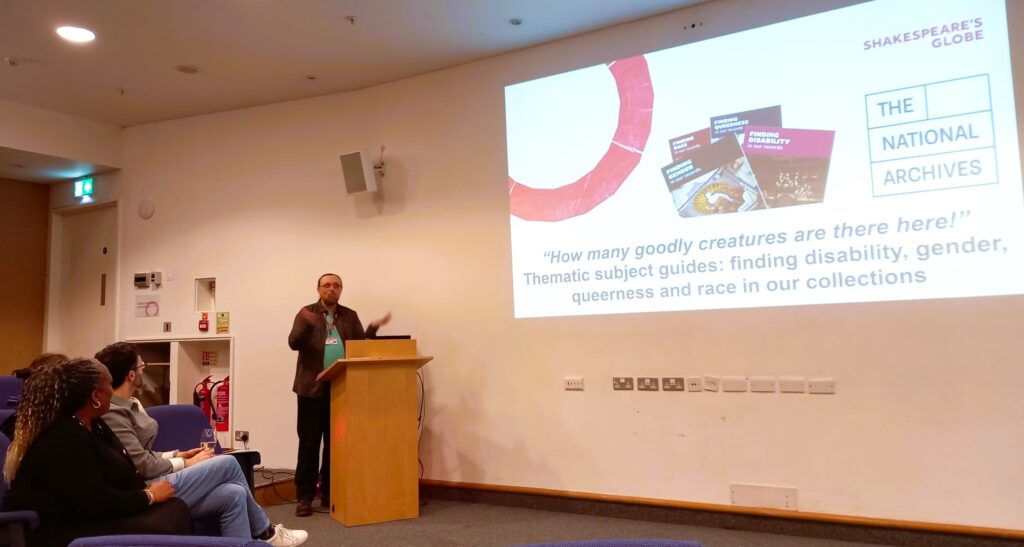
The Shakespeare Globe Trust is an educational Charity. Its “primary purpose is to promote, maintain, improve and advance education, by encouraging and stimulating public appreciation and understanding of the dramatic art in all its forms, but principally in relation to the works of William Shakespeare.” In further pursuit of this aim, Shakespeare’s Globe has recently launched four new Research Guides to its collections (one each for disability, gender, queerness and race). One reason for doing this work now was the planned opening of a new reading room, which will increase visibility of our work and offers us the opportunity to reach out to new audiences.
Produced with the help of a Research and Innovation Grant from The National Archives, those just released in a first edition at the Globe offer an alternative point of access to the catalogue, which meets the needs of those who have found catalogues to be a barrier to discoverability. However, they also allow for topic-based searches which catalogues have tended to hinder because descriptions have tended not to be subject-tagged. Moreover, they allow us to share multiple perspectives and possible interpretations, in contrast to a catalogue rooted in concisely stating the known facts. This means that they are not a duplication of existing work. They are also more capable of being packaged up as a project, than improving discoverability through an entire catalogue. Now significant research into our past has been undertaken, we can sustain future annual updates within existing staff time.
These four themes would be relevant to those seeking to improve discoverability in many Charity settings – even ones aimed at animal welfare likely have a diverse human heritage. However, in offering advice to other Charity archivists, it is important first to acknowledge the domestic culture war climate (where there is opposition to surfacing certain stories and perspectives, and doing so can be represented as divisive). Not all organisations may have the risk appetite to approve work that, as told by hostile newspapers, could upset an existing donor pool (even if it draws in others). If you have stakeholder buy-in, however, I recommend drawing on the lived experience of a broader community than just the archive team. At the Globe we recruited an Inclusion Advisory Panel to comment on the document drafts, who not only critiquing our language choices but actively shaped what was delivered.