
CHARM presenting on Climate Change and Charity Archives
On Wednesday March 6th 2024, CHARM presented at the History and Archives in Practice conference (HAP24), held at the University of Cardiff and organised by The National Archives, Royal Historical Society, and the Institute of Historical Research.
Four CHARM members – Archivists Thomas Poole (Islamic Relief Worldwide), Sophie Houlton (The National Trust), Lesley Hindley (British Trust for Ornithology) and myself, Gillian Boll (Amnesty International), gave a panel presentation titled “Charity Archives: Future Archives of Climate Change? The Perspective of UK-based Charity Archivists”.
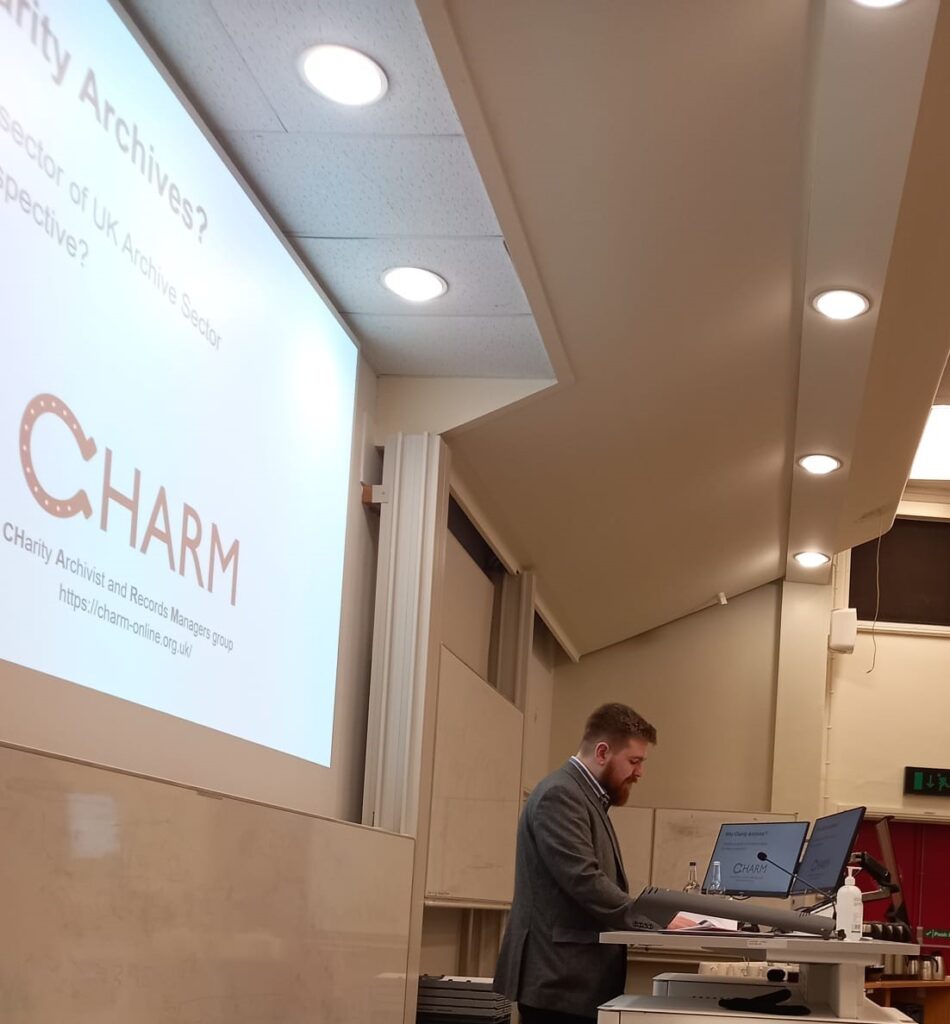
The idea for this presentation came out of a CHARM regular standing order on The Climate Emergency. In recent years, discussions around climate change and archives have largely centred around the impact of climate change upon recordkeeping itself. This might include concerns about how volatile weather will affect environmental preservation, socio-economic pressures will affect public archive services, or about how repositories need to minimise energy consumption, such as via the reduction of HVAC usage. It has become increasingly clear among sector professionals that climate change presents a significant challenge to archival management.
However – beyond this, we started to think about ways in which archives actually document climate change. Beyond the scientific data, or the archives of the United Nations Framework Convention on Climate Change, what archival materials will exist for historians of tomorrow and the future?
It occurred to us that charities, with their specific involvement in relevant tasks, development goals, and projects, whether this is the conservation work of The National Trust and the British Trust for Ornithology, or the humanitarian work of Amnesty International and Islamic Relief Worldwide, might be uniquely placed to document the tangible effects of climate change.
So at the HAP24 conference, each of us presented our thoughts on these topics from the perspective of each of our organisations. Thomas Poole presented on the increasing focus of Islamic Relief Worldwide on those impacted by Climate Change and extreme weather disasters. Lesley Hindley talked of how records held by the British Trust for Ornithology were being used to track the rapid decline in birdlife and biodiversity, and Sophie Houlton from The National Trust demonstrated how their work is becoming dominated by climate-related challenges. Last year the National Trust produced the report “A Climate for Change” in which they say that climate change is “the single biggest threat” facing its 28,500 historic homes, 250,000 hectares of land and 780 miles of coastline.
For Amnesty’s part, I talked about how Climate Change is impacting the work we do as an organisation. Since today’s reports are tomorrow’s archives, a shift in what we’re doing will inevitably alter the kinds of records we absorb and preserve in the archive.
I explained some of the reasons why Climate Change is also a Human Rights Issue, including how it relates to our fundamental relationship with the Universal Declaration of Human Rights, specifically the rights to life, clean water, food, housing and medical care. And highlighted our Climate Justice campaigns and how environmental pressures do not impact us all equally.
I also looked at how terminology has changed over time, and how this will affect linked data and the findability of records and introduced some key reports and campaigns that we’ve worked on, such as:
https://www.amnesty.org/en/latest/news/2019/10/pakistan-hazardous-air/, https://www.amnesty.org/en/documents/pol30/3476/2021/en/
and https://www.amnesty.org/en/documents/ior40/6463/2023/en/
After all 4 of us had presented on our own experiences, we then gave a brief roundup of case studies that had been offered by other CHARM members including the Royal National Lifeboat Institution (RNLI), British Exploring Society and The Philanthropy Archive at the University of Kent.
Looking across all our participating CHARM collections, we pulled out some of the following commonalities:
- Organisation-wide Climate Action policies and initiatives
All of our organisations claim to be thinking about Climate Change to promote good stewardship and sustainable practices such as reducing carbon emissions, initiating greener transport initiatives and, perhaps most importantly, divesting from fossil fuels investors in their banking / pension providers. - Direct Impact of Climate Change on Organisations
Several CHARM members describe the strategic direction of their organisations becoming more reactive due to extreme weather events, extreme temperatures, and biodiversity loss. Staff, members and property are already being affected by flooding, wildfires and poor air quality, while Coastal Erosion and rising sea levels are requiring branch relocation (such as described in The National Trust report above, and at the RNLI). - Changes in Collecting Strategy
Some members are actively collecting climate-related material, while others are facilitating new interrogation of old records that either directly or indirectly relate to the environment, such as Oral Histories of those impacted by the changing climate and Historical data (such as at the BTO and the British Exploring Society). - Archival management – future challenges
All responsible heritage professionals are asking themselves questions about the use of HVAC Environmental controls and increasing investment in Passive Building standards. A huge topic is also the ecological impact of digitisation and Digital Records Management (RM) practices e.g. the hunger for energy and cooling systems in storage servers / cloud space. For example, as is being played out in Ireland, where one-fifth of its entire energy consumption is now being used by data centres.
We then asked CHARM members if Charity / Non-profit Archives are distinctly different from other archive collection functions (business / education / local authority etc) and have a unique or non-typical perspective on the records of Climate Change?
There was not a strong consensus here, most members said Yes or Maybe, but one said No. However one respondent gave this compelling answer:
“As charities largely exist to plug the gaps when government and the private sector has failed, the archives we hold record the results of these failures in a way governments and corporations often would never do.”
Finally, we ended our panel presentation with a provocation to the audience of Historians, Academics and fellow Information Management professionals to consider how Climate Change is affecting their institutions now, and in the future.
We ended with the slide you can see behind us in the photo below, of a map of the extent of expected sea-level-rise-caused flooding in Cardiff by 2050.
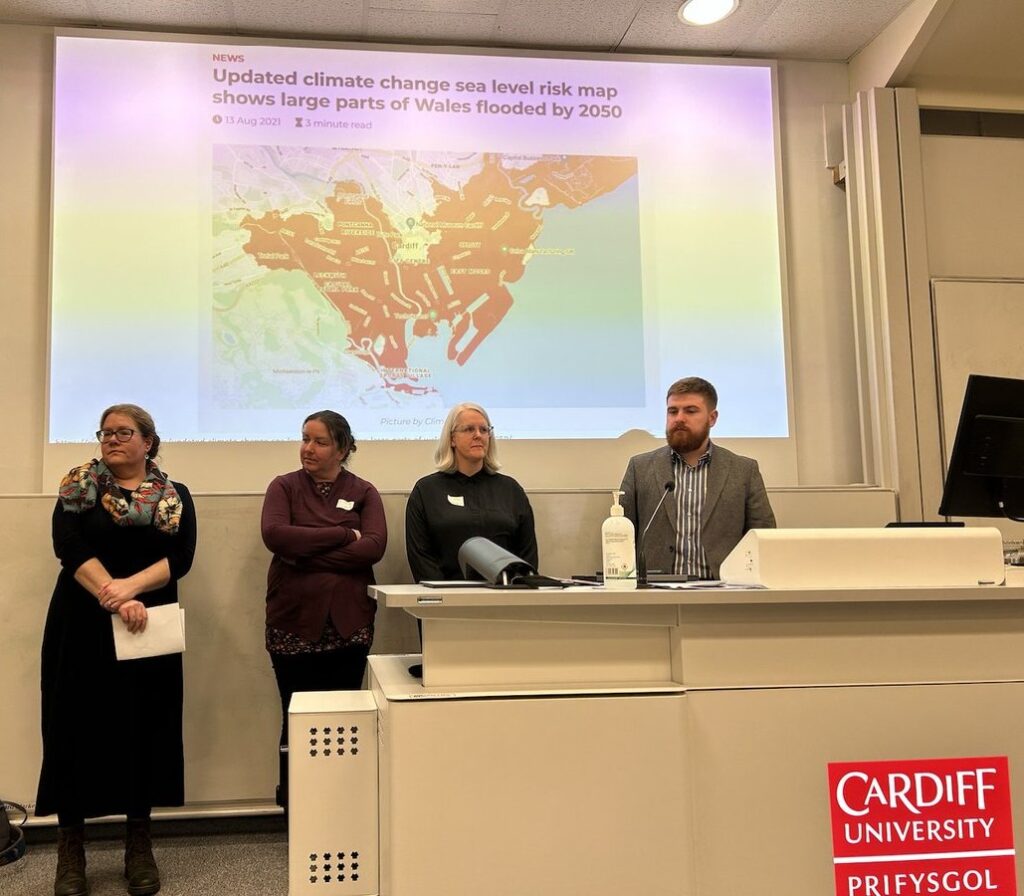
Our hypothesis therefore was that Charity / Non-Profit organisations may be “canaries in the coalmine”, seeing the impact of Climate Change in our work, and therefore archival records, in advance of other bodies. But that ultimately this is an issue that is coming towards us all, fast, and we asked our sector colleagues – how prepared are we?